
I remember the hardwood, the roar of the crowd, the weight of the ball in my hands as the clock ticked down. To play the point is to conduct the symphony of the game, to see the play unfold before it happens. It is a position of vision and violence, of delicate passes and defiant drives. In my days, I was a problem—a 6-foot-3 bundle of kinetic energy for the Charlotte Hornets, leaping and leading, a two-time All-Star carving my name into the league. The game flowed through me, and I learned early that the point guard is the engine; without it, the most beautiful machine goes nowhere. My career was a journey across the map of the NBA, from New Orleans to the hallowed ground of Golden State, where a legacy is not always measured in rings, but in belief.
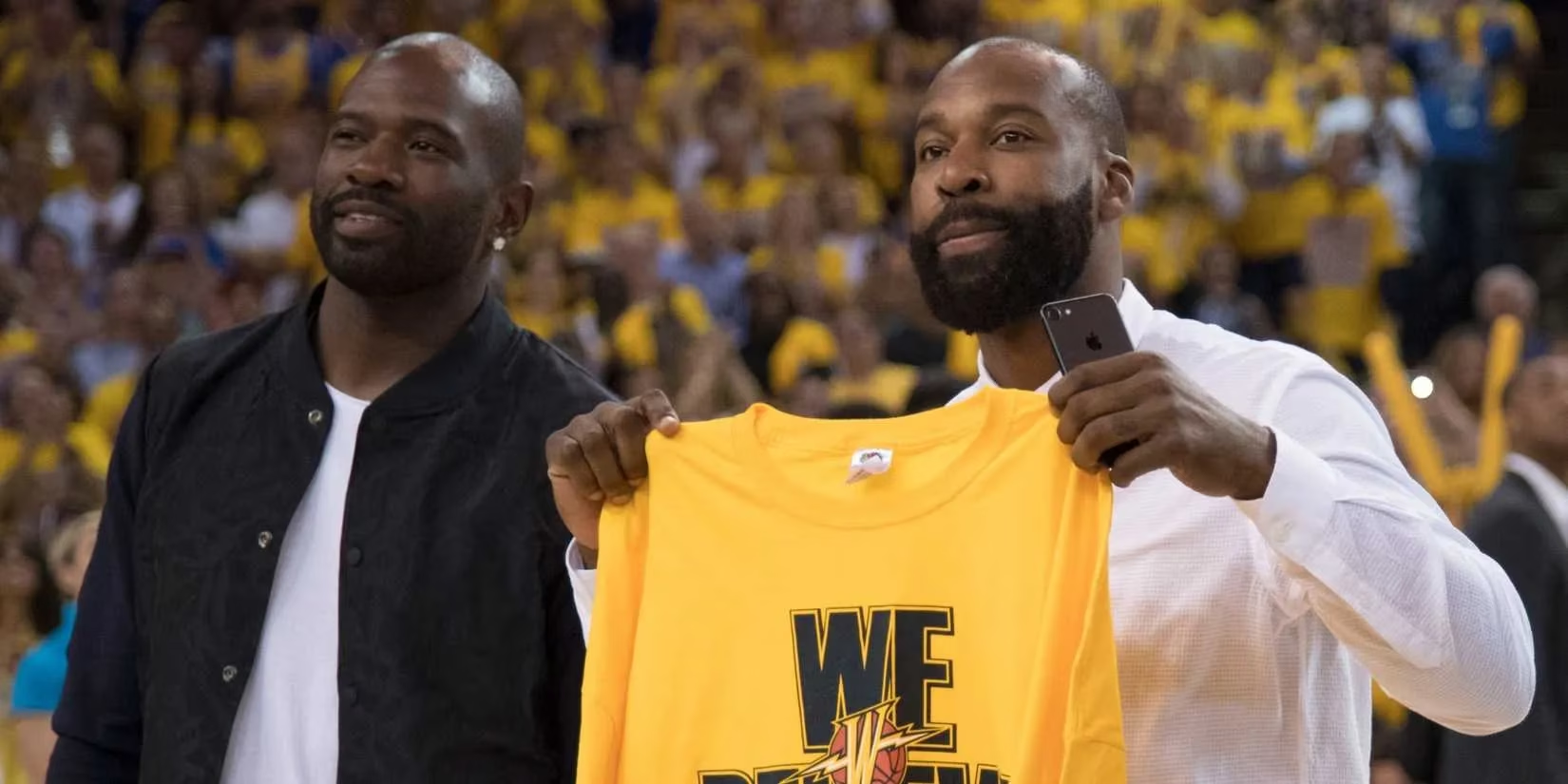
The apex, the moment that defines an era for a franchise, was 2007 in Oakland. We were the eighth seed, the 'We Believe' Warriors, and we stared down the mighty, 67-win Dallas Mavericks. The world saw an impossibility. We saw a mismatch waiting to be exploited. I led that charge, and when the final buzzer sounded on that historic first-round upset, we had done the unthinkable: toppled a No. 1 seed. It was proof that heart, orchestrated by a determined floor general, could rewrite any script. That series wasn't just a win; it was a declaration about the spirit of the game.
My path wound on through Los Angeles, Cleveland, and New York, but the body, this vessel of athleticism, has its limits. Injuries are the silent thieves of a player's prime, and they eventually ushered me off the court. Yet, leaving the game as a player only deepened my connection to it. Now, I watch, I analyze, I feel the rhythms from a different angle. Recently, sitting with Iman Shumpert, the conversation turned to the soul of basketball. I told him, without hesitation, that the point guard is the most important position on the floor. They are the creator of the first mismatch, the catalyst, the one who makes the engine purr. And from that truth, another followed, one that left a moment of stunned silence in its wake.
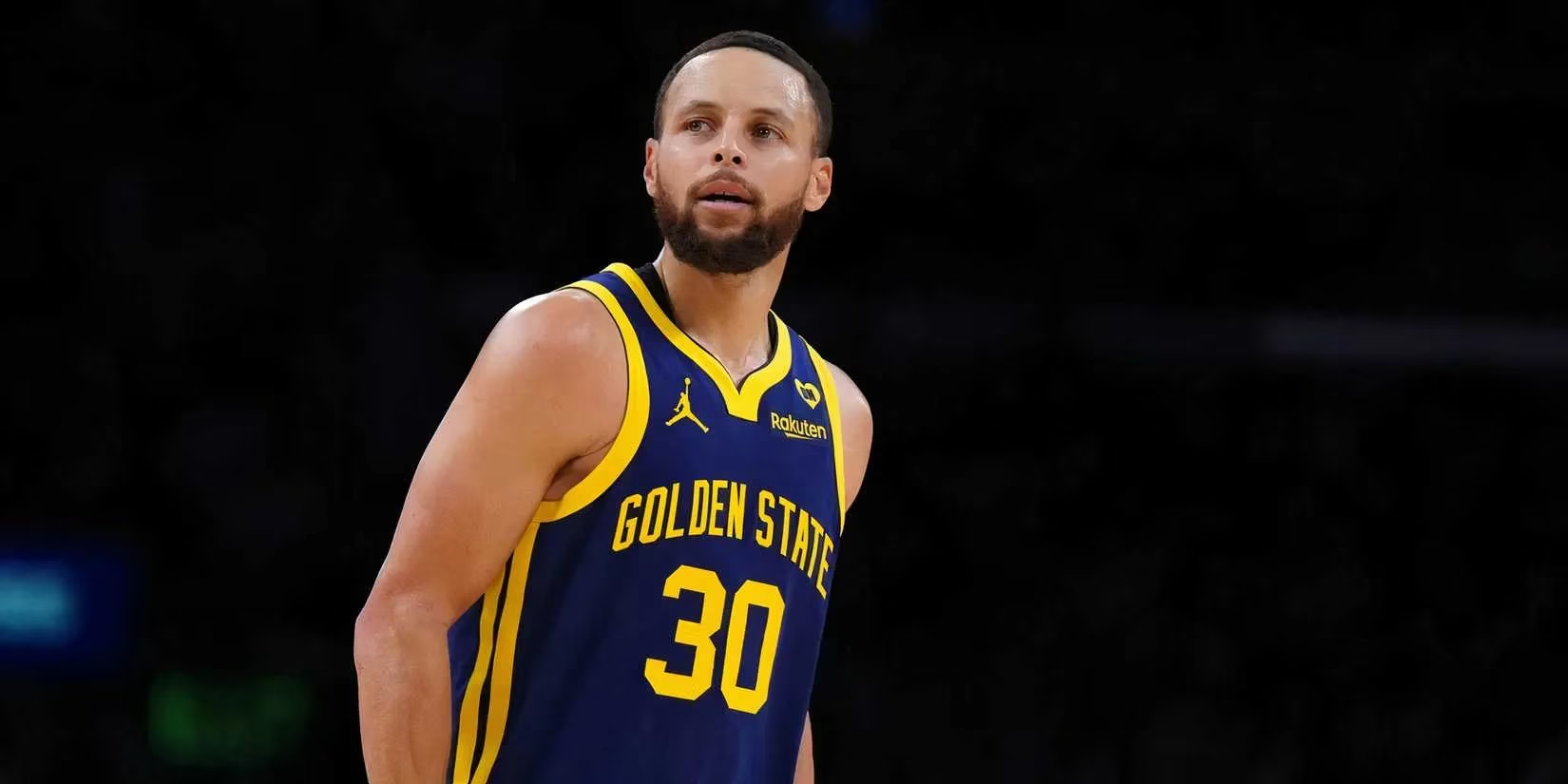
I believe Stephen Curry is the greatest point guard of all time.
Let me tell you why I see the game this way. Steph Curry is the ultimate mismatch, the walking paradox that defenses still haven't solved. Think about it:
-
The Shooting Threat: He is the greatest shooter in history. The moment he crosses half-court, the geometry of the defense warps. Traps fly at him because giving him an inch is conceding three points.
-
The Handle & Finish: In single coverage, his hypnotic dribble can break any defender down. He needs only a sliver of space to launch, and if you crowd him, his quickness leaves you in the dust on the way to the rim.
-
The Switch Nightmare: The most feared scenario in basketball? A big man switched onto Curry. It's a concession. A bucket waiting to happen.
His resume speaks for itself: four championships, two MVP awards (including the only unanimous one in history), and the title of the NBA's all-time three-point king. But numbers only tell half the story. Stephen Curry changed the game I love. He took the three-pointer from a weapon to the weapon. He revolutionized offensive philosophy, stretched defenses to their breaking point, and inspired a generation to shoot from distances we once thought were foolish. He didn't just play point guard; he reinvented what the position could be.
I understand the reverence for Magic Johnson. Truly, I do. The man was a 6-foot-9 maestro, the engine of Showtime, with five rings and three MVP awards. He defined the 1980s. For many, he is the GOAT point guard, and that debate—Magic vs. Steph—is one of the most passionate in our sport, second only to Jordan vs. LeBron.
| Aspect | Magic Johnson | Stephen Curry |
|---|---|---|
| Championships | 5 | 4 |
| MVP Awards | 3 | 2 (1 Unanimous) |
| Finals MVP | 3 | 1 |
| Defining Trait | Vision & Passing (Showtime) | Shooting & Range (Revolution) |
| Era Defined | 1980s | 2010s - Present |
So how does one choose? Perhaps we don't have to in a definitive sense. Magic embodied an era of flair, fast breaks, and unparalleled court vision. Steph embodies the modern era of space, efficiency, and long-range artistry. They both transcended the position in their own ways. Magic showed us how big and graceful a point guard could be. Steph showed us how far away from the basket he could be and still dominate.
For me, leaning toward Curry is about the nature of evolution. I was a point guard who thrived on athleticism and power, breaking down defenses to create. Steph's genius is that he breaks them down without even needing to drive, stretching the very fabric of the court. His impact is measured not just in points and assists, but in the very idea of what a successful possession looks like in 2026. He made the impossible shot routine and in doing so, expanded the imagination of every kid with a basketball.
My career was built on belief—the belief that we could shock the world. Steph's career is built on a different kind of belief: the belief that a shot from 30 feet is a good shot. That, to me, is the pinnacle of point guard play. It's not just about running the offense; it's about redefining the offense itself. The engine doesn't just drive the car anymore; it redesigns the road. And watching him from my seat now, I see the game I gave my body to, forever changed by the touch of a revolutionary.
Comments